

Essential Safety and Code Standards for Residential Elevator Selection
Installing a residential elevator is a significant infrastructure investment that directly impacts the long-term safety and accessibility of your home. According to recent industry data, the global residential elevator market is projected to grow at a compound annual growth rate of over 5% through 2030, driven by an aging population and increased demand for aging-in-place solutions. This surge in adoption makes understanding the regulatory landscape more critical than ever. Industry reports indicate that failure to comply with local building codes can result in costly retrofits, insurance claim denials, and serious safety hazards. This guide outlines the mandatory safety standards, code requirements, and selection criteria homeowners must evaluate before purchasing a lift. (About https arelevatorusa com)
Understanding ASME A17.1 and CSA B44 Standards
The foundation of residential elevator safety lies in the American Society of Mechanical Engineers (ASME) A17.1 code. ASME A17.1 is the Safety Code for Elevators and Escalators, which establishes the minimum requirements for the design, construction, installation, operation, inspection, testing, and maintenance of elevators. In Canada, the equivalent standard is CSA B44. For homeowners, these codes dictate everything from door interlocks to emergency communication systems.
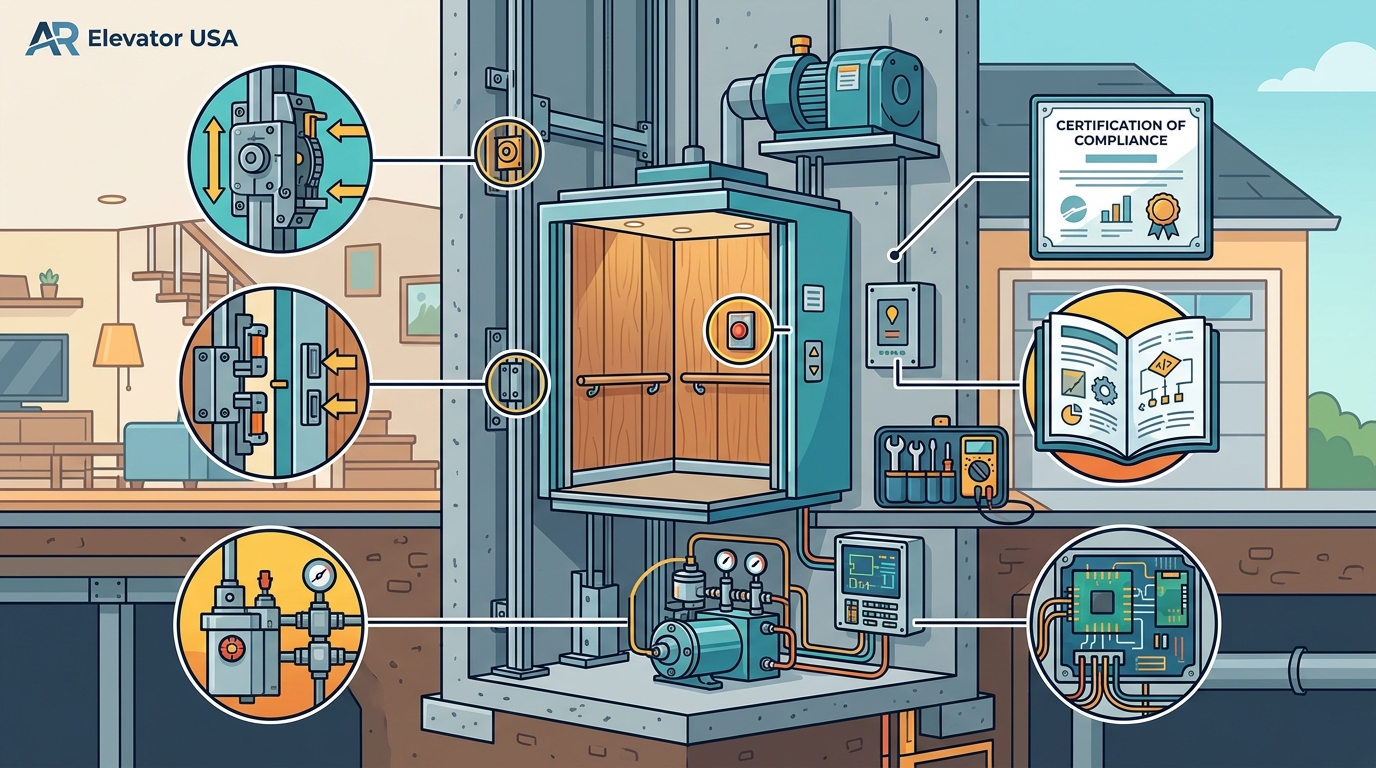
Compliance with these standards ensures that the elevator operates safely under all conditions. The code requires specific safety features, such as:
- Door Interlocks: Mechanisms that prevent the elevator car from moving if the doors are not fully closed and locked.
- Emergency Braking Systems: Devices that stop the car in the event of overspeed or cable failure.
- Communication Devices: A two-way communication system allowing passengers to contact emergency services if trapped.
When selecting a residential elevator, verify that the manufacturer and installer are certified to meet these specific ASME standards. ASME certification is the gold standard for safety compliance in the United States. Ignoring these codes can void home insurance policies and create liability issues during property sales.
Residential Platform Lifts vs. Full Elevators
Not all vertical transportation solutions are classified as elevators. Understanding the distinction between a residential platform lift and a full residential elevator is crucial for code compliance and safety.
Residential Platform Lifts are vertical or inclined transportation devices designed primarily for wheelchair users or individuals with mobility impairments. They often fall under different code sections, such as ASME A18.1, which covers low-rise transportation applications. These lifts typically have slower speeds and smaller capacities compared to full elevators.
In contrast, Residential Elevators are full-scale passenger lifts designed for general use within a home. They must adhere to the stricter ASME A17.1/CSA B44 codes. Key differences include:
| Feature | Residential Platform Lift | Full Residential Elevator |
|---|---|---|
| Primary Code Standard | ASME A18.1 | ASME A17.1 / CSA B44 |
| Speed | Low (typically under 30 fpm) | Variable (30-100+ fpm) |
| Capacity | Lower (often 750-1000 lbs) | Higher (1000-1400+ lbs) |
| Accessibility | Wheelchair focused | General passenger access |
| Installation Complexity | Low (often no pit required) | High (requires pit and machine room or MRL) |
Choosing the wrong type for your needs can lead to safety gaps. For example, a platform lift may not provide the stability or speed required for elderly residents who are not wheelchair users but need reliable vertical access. Platform lift services are specialized for specific mobility needs, whereas full elevators offer broader utility.
Power Efficiency and Sustainable Design
Modern residential elevators are not just about safety; they are also about energy efficiency. Traditional hydraulic elevators, while reliable, can be energy-intensive due to the constant circulation of hydraulic fluid. Newer technologies, such as machine-room-less (MRL) traction elevators and gearless systems, offer significant power savings.
Energy-Saving Elevators utilize regenerative drives that convert potential energy into electricity during braking, feeding it back into the building's grid. This technology can reduce energy consumption by up to 70% compared to traditional systems. For homeowners concerned about sustainability, selecting an elevator with green building certifications is essential.
Key efficiency features to look for include:
- LED Lighting: Low-energy interior and exterior lighting.
- Standby Modes: Systems that automatically power down non-essential components when not in use.
- Permanent Magnet Motors: More efficient than traditional induction motors.
AR Elevator USA specializes in power-efficient elevator solutions that align with modern green building standards. These systems not only reduce your carbon footprint but also lower long-term operational costs.
Nevada Code Compliance and Regulatory Oversight
Local regulations play a significant role in elevator installation. In Nevada, the Department of Business and Industry oversees elevator safety. Nevada state elevator regulations require annual inspections and strict adherence to ASME codes for all installed vertical transportation devices. Homeowners must ensure that their elevator installer is licensed and familiar with local jurisdictional requirements.
Non-compliance can result in:
- Fines and penalties from local building departments.
- Inability to obtain a certificate of occupancy for new constructions.
- Difficulty in selling the property due to unresolved code violations.
AR Elevator USA provides professional code compliance consultancy services to navigate these complex regulations. Our team ensures that every installation meets or exceeds Nevada state requirements, providing peace of mind for homeowners.
Smart IoT Monitoring and Predictive Maintenance
The integration of Internet of Things (IoT) technology is revolutionizing residential elevator safety. Smart elevators can monitor their own health in real-time, predicting failures before they occur. This proactive approach minimizes downtime and enhances safety.
Giga Lift Smart IoT Elevator Services provide real-time monitoring and predictive maintenance capabilities for residential and commercial elevators. These systems use sensors to track vibration, temperature, and motor performance, alerting technicians to potential issues via a cloud-based dashboard.
Benefits of IoT-enabled elevators include:
- Reduced Downtime: Issues are addressed before they cause a breakdown.
- Enhanced Safety: Continuous monitoring ensures all safety systems are functioning correctly.
- Remote Diagnostics: Technicians can diagnose problems remotely, reducing service call times.
For homeowners seeking the latest in safety technology, Giga Lift IoT services offer a cutting-edge solution that keeps your elevator running smoothly and safely.
Key Selection Factors for Homeowners
When selecting a residential elevator, consider the following critical factors:
- Code Compliance: Ensure the elevator meets ASME A17.1 and local Nevada codes.
- Safety Features: Verify the presence of emergency brakes, communication devices, and door interlocks.
- Energy Efficiency: Choose models with regenerative drives and LED lighting.
- Maintenance Support: Select a provider that offers 24/7 emergency response and preventive maintenance.
- Smart Technology: Consider IoT-enabled systems for predictive maintenance and real-time monitoring.
Key Takeaways
- ASME A17.1 is the primary safety code for residential elevators in the United States.
- Residential platform lifts follow ASME A18.1, while full elevators follow ASME A17.1.
- Nevada requires annual inspections and strict code compliance for all elevator installations.
- IoT-enabled elevators offer predictive maintenance, reducing downtime and enhancing safety.
- Energy-efficient models can reduce power consumption by up to 70%.
- AR Elevator USA provides licensed, full-service elevator solutions in Nevada.
- Professional code compliance consultancy is essential for navigating local regulations.
Frequently Asked Questions
What is the primary safety code for residential elevators?
The primary safety code is ASME A17.1, which covers the design, installation, and maintenance of elevators. In Canada, the equivalent is CSA B44.
Do I need a permit to install a residential elevator in Nevada?
Yes, most jurisdictions in Nevada require a building permit and subsequent inspections to ensure compliance with state and local codes.
What is the difference between a platform lift and a residential elevator?
Platform lifts are designed for wheelchair users and follow ASME A18.1, while residential elevators are for general passenger use and follow ASME A17.1.
How often should a residential elevator be inspected?
Annual inspections are typically required by law in Nevada to ensure ongoing safety and code compliance.
What are the benefits of IoT-enabled elevators?
IoT elevators offer real-time monitoring, predictive maintenance, and remote diagnostics, which reduce downtime and enhance safety.
Can AR Elevator USA help with code compliance?
Yes, AR Elevator USA provides professional code compliance consultancy services to ensure your elevator meets all Nevada state regulations.
What is Giga Lift Smart IoT?
Giga Lift is a smart IoT elevator service that provides intelligent connectivity, predictive maintenance, and real-time monitoring for enhanced safety and efficiency.
Contact Us
Ensuring your residential elevator meets all safety and code standards is vital for your family's well-being. AR Elevator USA is your trusted partner for licensed, code-compliant elevator solutions in Nevada. Contact us today to schedule a consultation or request a quote for your installation or modernization project.
Contact AR Elevator USA to learn more about our services.