

Vertical transportation in private homes has evolved from a luxury for the wealthy to a standard accessibility feature for multi-story living. According to recent industry data, the global residential elevator market is projected to grow significantly, with millions of new installations occurring annually across North America and Europe. This surge is driven by an aging population and a shift toward aging-in-place design principles. Understanding the mechanical differences between elevator types is critical for homeowners, architects, and builders to make informed decisions that balance budget, space, and long-term reliability.
Hydraulic Elevator Systems
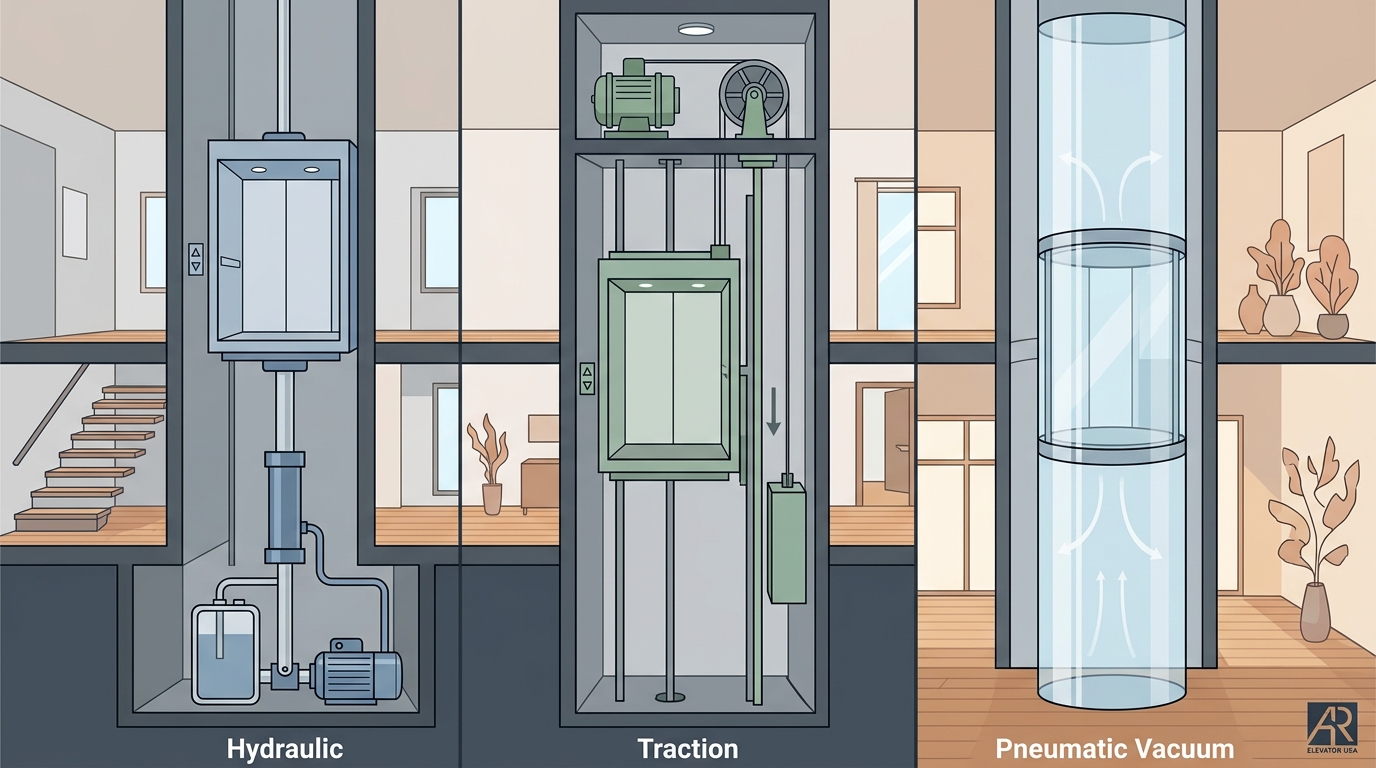
Hydraulic elevators represent the most traditional form of residential vertical transportation. These systems operate using a hydraulic piston and cylinder mechanism. A pump pushes fluid into the piston, which physically lifts the elevator car. When the car needs to descend, the fluid is released back into a reservoir, allowing gravity to lower the car smoothly.
Hydraulic elevator is a mechanical system that uses fluid pressure to raise and lower a cabin. This design is particularly popular in homes with basements or crawl spaces because the machinery can be installed on the ground floor. The simplicity of the mechanism often results in lower initial installation costs compared to complex traction systems.
Advantages of Hydraulic Systems
One of the primary benefits of hydraulic elevators is their reliability in low-rise applications. They are excellent for homes with three or fewer floors. The system is generally quieter than older traction models because there are no counterweights or complex gear trains involved in the primary lifting mechanism. Additionally, hydraulic elevators are known for their smooth starting and stopping, which enhances rider comfort.
Disadvantages and Maintenance
However, hydraulic systems have notable drawbacks. They are less energy-efficient because the pump must run continuously to maintain pressure. In the event of a seal failure, hydraulic fluid can leak, posing environmental concerns and requiring costly repairs. For homeowners in Nevada, where energy codes are becoming stricter, the power consumption of hydraulic systems is a significant consideration. AR Elevator USA offers power-efficient elevator solutions to help mitigate these energy concerns through modern upgrades.
Machine-Room-Less (MRL) Traction Elevators
Machine-Room-Less (MRL) elevators have become the industry standard for new residential constructions. Unlike traditional traction elevators that require a separate machine room at the top of the shaft, MRL systems place the drive machine inside the hoistway, typically at the top. This innovation eliminates the need for a dedicated mechanical room, saving valuable square footage in the home.
Machine-Room-Less elevator is a traction-based system where the drive components are integrated into the hoistway structure. These systems use a gearless motor and a counterweight to balance the weight of the car. The counterweight reduces the amount of energy required to lift the cabin, making MRL elevators significantly more energy-efficient than hydraulic models.
Space Efficiency and Design
The elimination of the machine room allows for greater architectural flexibility. Homeowners can utilize the space previously reserved for machinery for storage, closets, or additional living areas. The gearless motor technology used in MRL elevators provides a smoother, quieter ride compared to geared traction systems. This makes them ideal for luxury homes where aesthetics and noise levels are paramount.
Reliability and Modernization
MRL elevators are highly reliable and require less maintenance than hydraulic systems. They do not rely on hydraulic fluid, which eliminates the risk of leaks. Furthermore, modern MRL systems can be integrated with smart building technologies. AR Elevator USA specializes in Giga Lift Smart IoT Elevator Services, which provide real-time monitoring and predictive maintenance for these advanced systems.
Pneumatic Vacuum Elevators
Pneumatic vacuum elevators, often referred to as tube elevators, offer a unique alternative to traditional mechanical systems. These elevators consist of a transparent acrylic tube and a cabin that moves within it. The system uses a vacuum pump to create a pressure differential. The higher atmospheric pressure below the cabin pushes it upward, while releasing the vacuum allows it to descend.
Pneumatic vacuum elevator is a self-contained vertical transportation system that uses air pressure differentials for movement. Because the system is self-contained, it does not require a pit, machine room, or overhead hoistway. This makes installation possible in almost any existing home with minimal structural modification.
Installation and Aesthetics
The primary advantage of pneumatic elevators is their ease of installation. They can be installed in a weekend, causing minimal disruption to the household. The transparent design adds a modern, architectural element to the home, allowing natural light to flow through the shaft. However, these systems are generally limited to two or three stops and have a lower weight capacity compared to hydraulic or traction elevators.
Energy and Maintenance
While pneumatic elevators are energy-efficient during operation, the vacuum pump must run to maintain the seal. Maintenance is straightforward, as the system has fewer moving parts than hydraulic or traction models. However, the acrylic tube may require cleaning to maintain clarity, and the vacuum pump may need periodic servicing. For homeowners seeking a low-maintenance solution, residential elevator services can help determine if this type fits their specific structural constraints.
Rack and Pinion Elevators
Rack and pinion elevators are a less common but highly effective option for specific residential applications, particularly those with limited headroom or unique structural challenges. These systems use a motorized pinion gear that engages with a vertical rack attached to the hoistway wall. As the pinion rotates, it drives the car up and down the rack.
Rack and pinion elevator is a mechanical lift system that uses a gear and toothed rail mechanism for vertical movement. This design is often used in platform lifts and vertical reciprocating conveyors (VRCs) but is also adapted for residential use in tight spaces. The system is robust and can handle heavy loads, making it suitable for homes with accessibility needs.
Structural Requirements
Rack and pinion systems require a sturdy mounting structure for the rack. This can be a challenge in older homes with weaker framing. However, the system does not require a pit or machine room, similar to pneumatic elevators. The noise level can be higher than hydraulic or MRL systems, but modern designs have improved significantly in this regard.
Applications and Compliance
These elevators are often used in situations where traditional elevator shafts are not feasible. They are compliant with ASME B20.1-2018 standards for vertical conveyors. AR Elevator USA provides platform lift and VRC services for clients who need robust, industrial-grade solutions adapted for residential use.
Comparative Analysis of Residential Elevator Types
Choosing the right elevator type depends on several factors, including budget, home structure, and long-term maintenance preferences. The following table summarizes the key differences between the primary residential elevator types.
| Elevator Type | Power Source | Space Requirements | Energy Efficiency | Best For |
|---|---|---|---|---|
| Hydraulic | Hydraulic Fluid | Pit Required, No Machine Room | Low | Low-rise homes with basements |
| MRL Traction | Electric Motor | No Pit or Machine Room | High | New construction, luxury homes |
| Pneumatic | Vacuum Pump | No Pit or Machine Room | Medium | Existing homes, retrofits |
| Rack and Pinion | Electric Motor | Minimal Structural Changes | Medium | Tight spaces, heavy loads |
Key Takeaways
- Hydraulic Elevators: Best for low-rise homes with basements; lower initial cost but higher energy usage.
- MRL Traction Elevators: The industry standard for new builds; highly energy-efficient and space-saving.
- Pneumatic Elevators: Ideal for retrofits; no pit or machine room required but limited capacity.
- Rack and Pinion: Suitable for unique structural constraints; robust and reliable for heavy loads.
- Energy Efficiency: MRL and pneumatic systems generally outperform hydraulic systems in power consumption.
- Maintenance: MRL and pneumatic systems require less frequent maintenance than hydraulic systems.
- Smart Technology: IoT integration is available for MRL systems to enhance monitoring and safety.
Frequently Asked Questions
What is the most energy-efficient residential elevator?
Machine-Room-Less (MRL) traction elevators are generally the most energy-efficient. They use regenerative drives that convert potential energy back into electricity when the car descends. Pneumatic elevators are also efficient but lack the regenerative capabilities of MRL systems.
Do I need a machine room for a residential elevator?
No, modern residential elevators do not require a machine room. MRL traction elevators house the machinery in the hoistway, and pneumatic elevators are self-contained. Hydraulic elevators require a pump room, which can be small and located on the ground floor.
How much does a residential elevator cost?
Costs vary based on type and customization. Hydraulic elevators typically have lower upfront costs but higher long-term energy bills. MRL elevators have higher initial costs but offer better long-term value. Pneumatic elevators are mid-range in cost but offer easy installation. For accurate pricing, request a quote from AR Elevator USA.
Can I install an elevator in an existing home?
Yes, elevators can be installed in existing homes. Pneumatic and rack-and-pinion systems are particularly suitable for retrofits due to their minimal structural requirements. MRL elevators can also be installed with proper shaft construction. AR Elevator USA provides new elevator supply and installation services for both new and existing structures.
What safety standards apply to residential elevators?
Residential elevators must comply with ASME A17.1 and local building codes. AR Elevator USA ensures all installations meet ASME A17.1, A17.2, and A17.3 standards for safety and compliance.
How often do residential elevators need maintenance?
Regular maintenance is essential for safety and longevity. Hydraulic elevators typically require monthly service, while MRL and pneumatic systems may require quarterly or bi-annual service. AR Elevator USA offers comprehensive preventive maintenance services to keep your elevator running smoothly.
What is the lifespan of a residential elevator?
With proper maintenance, a residential elevator can last 20 to 30 years or more. MRL systems often have longer lifespans due to fewer moving parts. Hydraulic systems may require more frequent component replacements due to fluid wear and seal degradation.
Contact AR Elevator USA
Choosing the right residential elevator is a significant decision that impacts your home's value, accessibility, and comfort. AR Elevator USA is a licensed, full-service elevator partner serving Nevada and the Western region. We provide expert guidance on elevator types, installation, and modernization to ensure your vertical transportation solution meets your unique needs.
Contact us today to schedule a consultation. Our team of certified technicians is ready to help you design, install, and maintain your elevator system with precision and care. Visit our contact page or call 702-810-2757 to get started.