

Vertical transportation in private homes has evolved from a luxury niche to a standard accessibility requirement for multi-level living. According to recent industry data, the global residential elevator market is projected to grow significantly, driven by an aging population and the increasing demand for aging-in-place solutions. Understanding the mechanical differences between available systems is critical for homeowners, architects, and builders to ensure long-term reliability and energy efficiency. This guide details the primary elevator types, their operational mechanics, and their suitability for various residential structures.
Hydraulic Elevator Systems
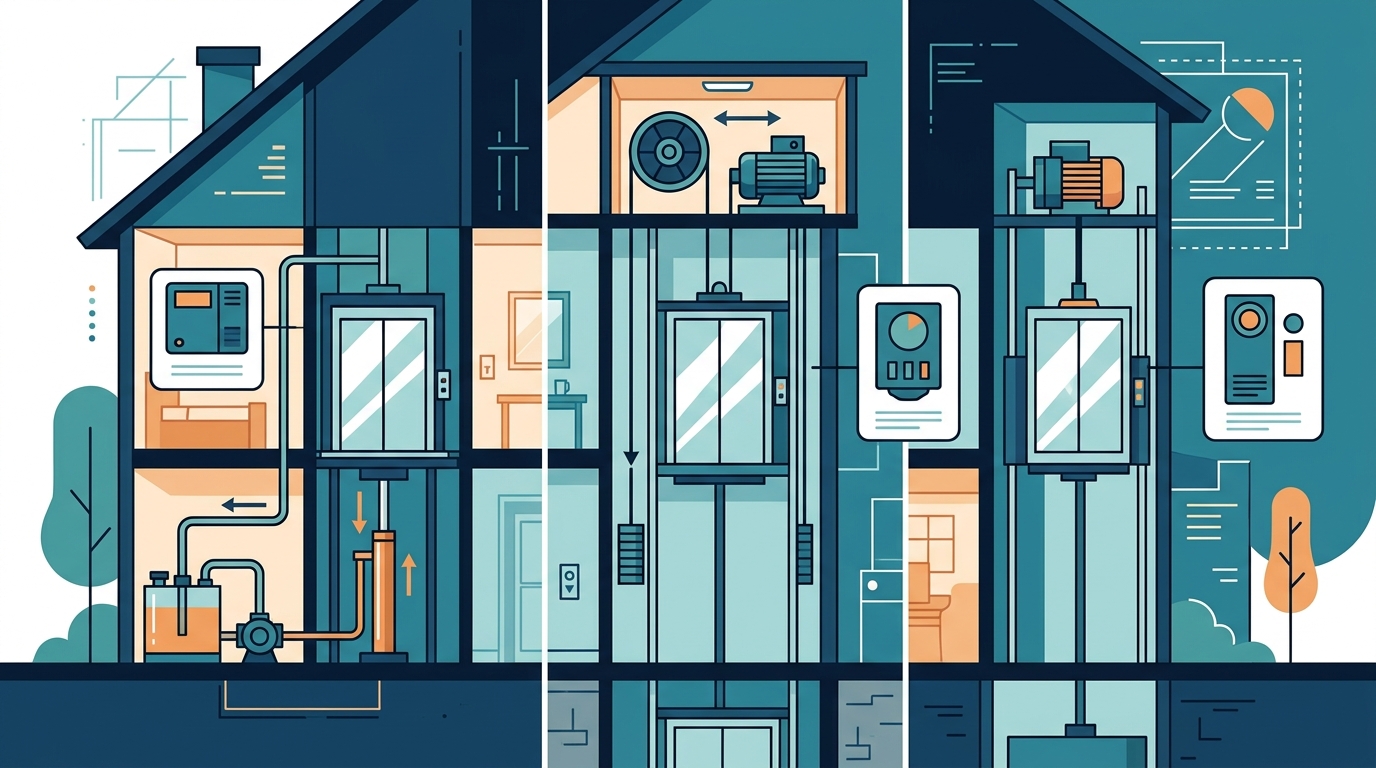
Hydraulic elevators remain one of the most common choices for residential installations, particularly in homes with basements or crawl spaces. Hydraulic elevator is a system that uses a piston and fluid to lift the cab. This mechanism operates similarly to a car jack, where a hydraulic pump pushes fluid into a cylinder, forcing the piston upward to raise the elevator car.
Operational Mechanics and Installation
The primary advantage of hydraulic systems is their simplicity and reliability. They do not require a machine room at the top of the shaft, which saves valuable square footage in smaller homes. However, the piston requires a corresponding depth in the ground, meaning these systems are best suited for homes with adequate basement depth or the ability to dig a pit. For homes without this depth, the piston can be mounted alongside the shaft, though this requires additional lateral space.
Energy Efficiency and Maintenance
While hydraulic elevators are known for their smooth ride and heavy load capacity, they have historically faced criticism regarding energy efficiency. The pump motor must run continuously to maintain pressure, which can lead to higher electricity consumption. However, modern advancements have introduced regenerative drives that capture energy during descent, significantly improving their power profile. AR Elevator USA offers power-efficient elevator solutions that address these traditional concerns, ensuring that homeowners do not have to compromise on sustainability.
Machine-Room-Less (MRL) Traction
Machine-Room-Less (MRL) elevators represent the modern standard for mid-to-high-rise residential buildings and luxury estates. MRL elevator is a traction-based system where the drive machinery is located within the hoistway. Unlike traditional traction elevators that require a separate machine room at the top of the shaft, MRL systems place the motor and controller inside the shaft, typically above the cab.
Space Optimization
The elimination of the machine room allows for more flexible building design. Architects can utilize the space previously reserved for the machine room for additional living areas, storage, or mechanical rooms. This is particularly beneficial in urban settings where square footage is at a premium. The compact nature of MRL equipment also reduces the overall structural load on the building.
Performance and Speed
MRL elevators are capable of higher speeds than hydraulic systems, making them ideal for homes with three or more stories. They offer a quieter, smoother ride due to the use of steel ropes and counterweights, which balance the weight of the cab. This balance reduces the energy required to move the elevator, contributing to lower operational costs over time. For detailed information on our installation capabilities, visit our New Elevator Supply & Installation Services page.
Pneumatic Vacuum Elevators
Pneumatic vacuum elevators, often referred to as tube elevators, offer a unique alternative for homes where traditional mechanical systems are impractical. Pneumatic elevator is a vacuum-driven lift that uses air pressure differentials to move the cab. The system consists of a transparent tube and a cab that sits inside it. A vacuum pump removes air from the tube, creating a pressure differential that lifts the cab to the desired floor.
Installation Flexibility
One of the most significant advantages of pneumatic elevators is their minimal structural requirement. They do not need a pit, a machine room, or a counterweight system. This makes them an excellent choice for retrofitting existing homes where digging a pit or modifying the roof structure is not feasible. The transparent design also adds an aesthetic element, turning the elevator into a visual feature of the home.
Limitations and Considerations
While pneumatic elevators are easy to install, they are generally limited to two or three stops due to the physics of air pressure. They also tend to be slower than traction or hydraulic systems. However, their energy consumption is low, and they require very little maintenance because there are no complex mechanical parts like ropes or pistons. For more on our specialized platform lift and VRC services, which complement residential vertical transportation needs, please explore our service catalog.
Rack and Pinion Mechanisms
Rack and pinion elevators are a robust, industrial-grade solution that has found its way into high-end residential applications, particularly for heavy loads or challenging architectural constraints. Rack and pinion elevator is a gear-driven system that uses a toothed rack and a rotating pinion gear. As the motor turns the pinion, it engages with the rack, physically pushing or pulling the cab along the shaft.
Heavy Load Capacity
This system is exceptionally durable and can handle heavier loads than many traditional residential elevators. It is often used in homes with large freight elevators or those requiring accessibility for heavy medical equipment. The mechanical simplicity of the gear system means fewer points of failure, contributing to long-term reliability.
Structural Requirements
Rack and pinion systems require a strong structural guide rail, which must be securely anchored to the building. This makes them less suitable for lightweight or temporary structures. However, for permanent installations in solid concrete or steel-framed homes, they offer unparalleled stability. We also provide residential elevator services tailored to specific structural needs, ensuring every installation meets safety and performance standards.
Comparative Analysis of Residential Options
Selecting the right elevator type depends on several factors, including home structure, budget, and intended use. The following table summarizes the key differences between the primary residential elevator types.
| Elevator Type | Best For | Space Requirement | Energy Efficiency | Typical Speed |
|---|---|---|---|---|
| Hydraulic | 2-3 story homes with basements | Pit required or side-mount | Moderate (improving with regen) | Slow to Moderate |
| MRL Traction | 3+ story luxury homes | Minimal (no machine room) | High | Moderate to Fast |
| Pneumatic | Retrofitting, no pit homes | Minimal (tube only) | High | Slow |
| Rack & Pinion | Heavy loads, industrial use | Guide rail structure | Moderate | Slow |
For homeowners in Nevada and the Western region, understanding local code compliance is essential. We offer specialized code compliance services to ensure your installation meets all regional safety standards.
Key Takeaways
- Hydraulic Systems: Best for homes with basements; uses fluid pressure for smooth, reliable operation.
- MRL Traction: Ideal for taller homes; saves space by locating machinery within the shaft.
- Pneumatic Lifts: Perfect for retrofits; requires no pit or machine room, offering maximum installation flexibility.
- Rack & Pinion: Superior for heavy loads; uses mechanical gears for robust, durable performance.
- Energy Efficiency: Modern systems, including those with regenerative drives, significantly reduce power consumption.
- Code Compliance: All installations must adhere to ASME A17.1 standards for safety and regulatory approval.
- Local Expertise: AR Elevator USA provides tailored solutions for Nevada's unique architectural and regulatory landscape.
Frequently Asked Questions
What is the most energy-efficient residential elevator?
MRL traction elevators and modern hydraulic systems with regenerative drives are generally the most energy-efficient. Pneumatic elevators also consume low power but are limited in speed and height.
Do I need a basement for a hydraulic elevator?
Not necessarily. While a pit is standard, hydraulic pistons can be mounted alongside the shaft if basement depth is insufficient, though this requires additional lateral space.
Can I install an elevator in an existing home?
Yes, pneumatic and hydraulic elevators are commonly retrofitted into existing homes. MRL systems may require more structural modification depending on the roof and shaft design.
What is the difference between a platform lift and a residential elevator?
Platform lifts, such as VRCs, are often used for accessibility and have lower weight capacities and speeds compared to full residential elevators designed for passenger comfort and higher loads.
How often do residential elevators need maintenance?
Regular preventive maintenance is crucial. AR Elevator USA offers comprehensive preventive maintenance services to ensure long-term reliability and safety.
What safety standards apply to home elevators?
Home elevators must comply with ASME A17.1 safety codes. Our team ensures all installations meet these rigorous standards through professional annual inspection and testing.
What is the average cost of a residential elevator?
Costs vary based on type, stops, and customization. Hydraulic and pneumatic systems are often more affordable for retrofitting, while MRL systems offer better long-term value for new construction.
Contact AR Elevator USA
Choosing the right residential elevator is a significant investment in your home's value and your family's comfort. AR Elevator USA is a family-owned, local company proudly serving Nevada and the Western region. We provide expert guidance on new elevator supply and installation, modernization, and maintenance. Contact us today to schedule a consultation and discover how we can tailor a vertical transportation solution to your unique needs.