

Vertical transportation in private homes has evolved from a luxury for the ultra-wealthy to a standard accessibility feature for modern multi-story living. According to recent industry data, the global residential elevator market is projected to grow at a compound annual growth rate of over 5% through 2030, driven by aging populations and universal design principles. This surge in demand has led to a diverse array of mechanical systems, each offering distinct advantages regarding space, cost, and aesthetic integration. Understanding these differences is critical for homeowners, architects, and builders who must balance structural constraints with long-term operational reliability. This guide explores the primary elevator technologies available for residential use, analyzing their mechanics, installation requirements, and suitability for various home layouts. (About https arelevatorusa com)
Hydraulic Elevator Systems
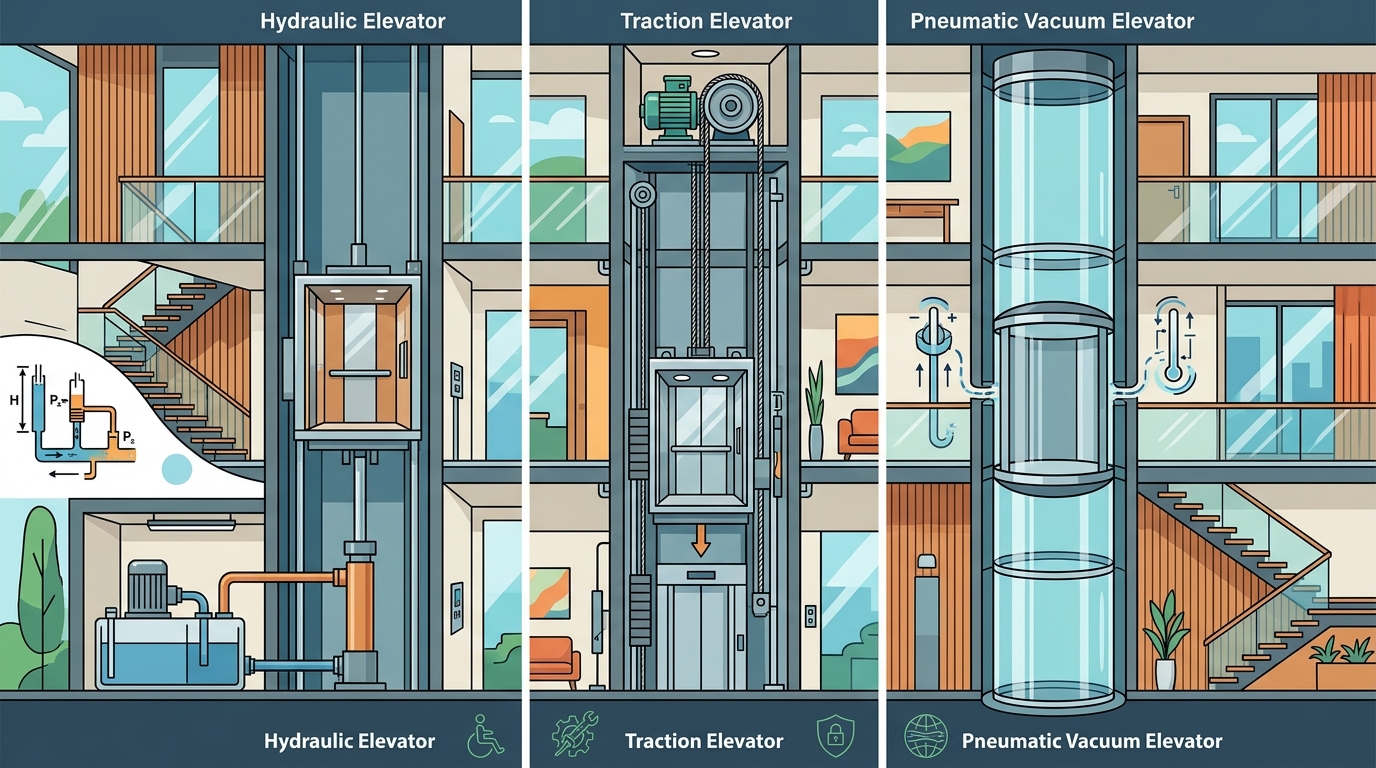
Hydraulic elevators represent the most traditional and widely installed type of residential lift. These systems operate on a simple yet robust principle: a piston located in a cylinder below the elevator car pushes the car upward. Hydraulic elevator is a mechanical system that uses fluid pressure to generate the force necessary to lift the cab. This technology is particularly favored for homes with basements or crawl spaces where the piston can be installed.
How It Works
The mechanism relies on an electric pump that forces hydraulic fluid into the cylinder. As the fluid enters, it pushes the piston up, raising the elevator car. To descend, a valve opens, allowing the fluid to return to a reservoir, and gravity pulls the car down. This process is smooth and provides a comfortable ride, though it can be slower than other modern systems. The simplicity of the design means fewer complex electronic components are required for basic operation.
Pros and Cons
The primary advantage of hydraulic systems is their ability to accommodate heavy loads and lower speeds, making them ideal for homes with limited shaft space or where a machine room is not feasible. They are also generally less expensive to install than traction systems. However, they require a pit depth for the piston, which can be a challenge in homes with shallow foundations. Additionally, environmental concerns regarding potential hydraulic fluid leaks have led to stricter regulations in some regions. For detailed information on maintenance protocols, ASME A17.1 standards provide the baseline for safety compliance in North America.
Machine-Room-Less (MRL) Traction
Machine-Room-Less (MRL) elevators have become the gold standard for new residential constructions and major renovations. Unlike traditional traction elevators that require a separate mechanical room at the top of the shaft, MRL systems house the drive machine and controller within the hoistway itself, typically above the car. Machine-Room-Less elevator is a design that eliminates the need for a dedicated mechanical room by integrating drive components into the shaft. This innovation allows for greater architectural flexibility and reduced construction costs.
Technical Advantages
MRL systems use a steel cable or belt to lift the car, similar to commercial elevators. The motor is mounted directly to the sheave, reducing energy consumption and mechanical wear. According to data from the Elevator World industry reports, MRL elevators account for a significant majority of new installations due to their energy efficiency and compact footprint. They offer faster travel speeds and smoother rides compared to hydraulic models, making them suitable for taller homes with three or more floors.
Installation Considerations
While MRL elevators are highly efficient, they require a properly constructed shaft with adequate headroom. The integration of the machine into the shaft means that the structural integrity of the top of the building must be assessed during the design phase. These systems are also compatible with modern IoT monitoring technologies, allowing for predictive maintenance that minimizes downtime. For homeowners in Nevada, understanding local code compliance requirements is essential for ensuring the system meets all safety regulations.
Pneumatic Vacuum Elevators
Pneumatic vacuum elevators offer a unique alternative for homes where traditional mechanical systems are not viable. These elevators use air pressure differentials to move the car. A vacuum is created in the tube surrounding the cab, and atmospheric pressure pushes the car up. To descend, air is allowed back into the tube, and gravity lowers the cab. Pneumatic vacuum elevator is a self-contained system that uses air pressure rather than cables or hydraulics for vertical movement.
Design and Aesthetics
One of the most appealing aspects of pneumatic elevators is their aesthetic versatility. They often feature a transparent acrylic tube, which can serve as a striking architectural element in a home. They require no pit, no machine room, and minimal structural modifications. This makes them an excellent choice for retrofitting into existing homes without major construction. However, they are generally limited to two or three stops and have a lower weight capacity compared to hydraulic or traction systems.
Operational Efficiency
While the initial installation cost can be higher than hydraulic systems, the operational costs are low due to minimal energy usage. The system only consumes power when creating the vacuum. For more information on sustainable vertical transportation, USGBC green building guidelines highlight the environmental benefits of energy-efficient elevator technologies. These systems are particularly popular in regions with strict environmental codes or where foundation depth is limited.
Rack and Pinion Technology
Rack and pinion elevators are a less common but highly effective solution for specific residential applications, particularly those with limited shaft space or unique structural constraints. This system uses a gear mechanism where a pinion gear on the elevator car engages with a rack (a toothed rail) fixed to the wall or structure. Rack and pinion elevator is a mechanical drive system that uses interlocking gears to lift the car along a fixed rail.
Structural Requirements
The primary requirement for a rack and pinion system is a strong structural wall to which the rack can be securely attached. This makes them suitable for homes with solid concrete or reinforced masonry walls. They are often used in narrow shafts where traditional cables or pistons would not fit. The system is known for its durability and low maintenance requirements, as there are no hydraulic fluids or complex electrical drives to manage.
Applications and Limitations
Rack and pinion elevators are often chosen for their compact size and ability to be installed in tight spaces. They are also relatively quiet during operation. However, the need for a robust structural wall can limit their applicability in homes with lightweight framing. For specialized installation needs, consulting with residential elevator specialists can help determine if this technology is viable for your specific home structure.
Comparing Residential Options
Selecting the right elevator type requires a careful evaluation of your home's architecture, budget, and long-term needs. The table below summarizes the key differences between the primary residential elevator technologies.
| Elevator Type | Space Requirements | Installation Complexity | Best For | Energy Efficiency |
|---|---|---|---|---|
| Hydraulic | Requires pit depth | Moderate | Single-family homes with basements | Moderate |
| MRL Traction | Minimal headroom needed | High | New construction, tall homes | High |
| Pneumatic Vacuum | No pit or machine room | Low | Retrofits, aesthetic focus | Very High |
| Rack and Pinion | Narrow shaft compatible | Moderate | Homes with solid structural walls | High |
Each system has distinct advantages. Hydraulic systems offer reliability and lower upfront costs. MRL traction systems provide speed and efficiency for larger homes. Pneumatic elevators offer design freedom and ease of installation. Rack and pinion systems provide a niche solution for structural constraints. For a comprehensive analysis of power efficiency in elevator systems, homeowners should consider long-term operational costs alongside installation expenses.
Key Takeaways
- Hydraulic Elevator systems are reliable and cost-effective but require a pit for the piston.
- MRL Traction elevators are the industry standard for new builds due to their energy efficiency and speed.
- Pneumatic Vacuum elevators require no pit or machine room, making them ideal for retrofits.
- Rack and Pinion systems are suitable for narrow shafts and homes with solid structural walls.
- Installation complexity varies significantly, with pneumatic systems being the easiest to retrofit.
- Energy efficiency is highest in MRL and pneumatic systems, reducing long-term operational costs.
- Compliance with ASME safety codes is mandatory for all residential elevator installations.
Frequently Asked Questions
Which residential elevator is the most energy-efficient?
MRL traction elevators and pneumatic vacuum elevators are generally considered the most energy-efficient. MRL systems use regenerative drives that can return energy to the building grid, while pneumatic systems only consume power during ascent.
Can I install a residential elevator in an existing home?
Yes, many residential elevator types, particularly pneumatic vacuum and hydraulic systems, are designed for retrofitting into existing homes. However, structural assessments are required to ensure the home can support the installation.
What is the difference between a hydraulic and a traction elevator?
Hydraulic elevators use a piston and fluid to lift the car, while traction elevators use cables and a counterweight system. Traction elevators are typically faster and more energy-efficient, while hydraulic systems are often simpler and less expensive to install.
How much space does a residential elevator require?
Space requirements vary by type. Pneumatic elevators require a circular footprint but no pit. Hydraulic elevators need a pit for the piston. MRL traction elevators require a shaft with adequate headroom but no machine room.
Are residential elevators safe for children and elderly users?
Yes, modern residential elevators are designed with multiple safety features, including emergency brakes, communication systems, and smooth acceleration/deceleration. Compliance with safety regulatory standards ensures high levels of protection for all users.
What maintenance do residential elevators require?
All elevators require regular maintenance. Hydraulic systems need fluid checks and seal inspections. Traction systems require cable and sheave inspections. Pneumatic systems need tube and seal checks. Preventive maintenance programs can extend the lifespan of the system.
How long does installation take?
Installation time varies based on the type and complexity. Pneumatic elevators can be installed in a few days. Hydraulic and traction systems may take several weeks due to construction and wiring requirements.
Contact AR Elevator USA
Choosing the right residential elevator is a significant decision that impacts your home's functionality, safety, and value. AR Elevator USA specializes in providing tailored elevator solutions for residential properties across Nevada and the Western region. Our team of certified technicians and engineers can help you navigate the complexities of installation, compliance, and maintenance. Whether you are considering a new installation or a modernization project, we offer transparent pricing and expert guidance. Contact us today to schedule a consultation and discover how we can enhance your home with a reliable, code-compliant vertical transportation system. Visit our contact page to request a quote or learn more about our services.